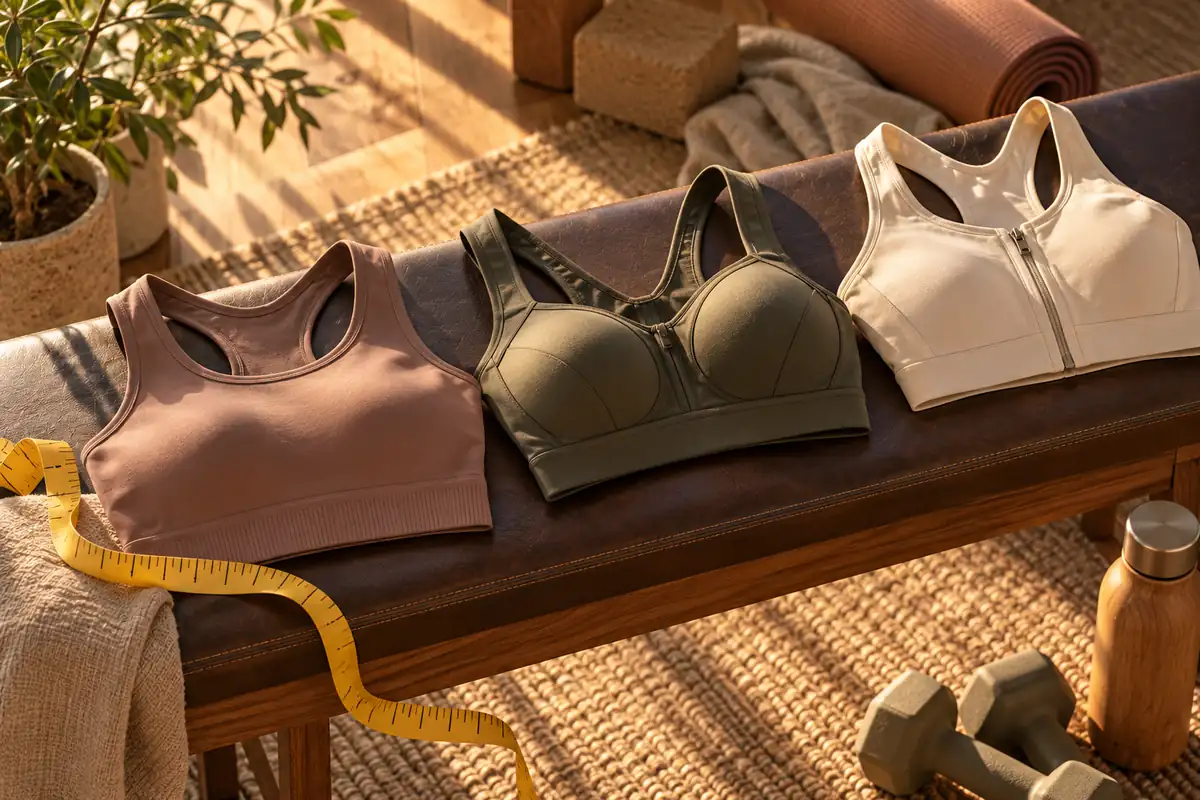
Sports bras look alike on a hanger, but they hold the breasts in different ways. Picking the right type matters more than picking the right brand.
The three main types
Compression. A pull-on crop top that presses the breasts against the chest wall to limit movement. Usually sized XS to XL, often with a racerback. Comfortable and simple, but the more volume there is, the less a flat squeeze can control.
Encapsulation. Separate molded or seamed cups hold and lift each breast on its own, much like an everyday bra. Usually sized by band and cup, with hooks and adjustable straps. Better shape, better control for larger busts.
Combination. Encapsulation cups with a compression layer over them. This gives the most bounce control and is the usual choice for running, jumping and fuller busts.
Back and front styles
- Racerback: the straps meet between the shoulder blades. It spreads the load and stops straps slipping, and leaves the shoulders free to move.
- Standard straps: easier to put on and adjust, and often convertible to racerback with a clip.
- Front-zip or front-closure: opens at the front, so it is easier to get on and off when you are sweaty or have limited shoulder movement. Look for a fabric guard behind the zip.
- Back hooks: let you set the band firmness, and loosen it as the elastic ages.
Impact levels
| Impact | Typical activities | What to look for |
|---|---|---|
| Low | Yoga, walking, Pilates, stretching | Soft compression, light support |
| Medium | Cycling, hiking, strength training | Firmer compression or light encapsulation |
| High | Running, HIIT, jumping, team sports | Encapsulation or combination, wide straps, firm band |
Impact labels come from the maker and are not standardized. Testers have found bras labeled medium that hold like high-impact bras, and the reverse. Try a jump test before you trust the label.
Choosing by cup size
- A to B cups: compression bras work for most activities. Many people at these sizes also run in a firm compression bra.
- C to D cups: compression for low impact. For running, encapsulation or combination.
- DD and above: encapsulation or combination for anything above low impact, ideally sized by band and cup. Wide straps and a wide, firm underband take weight off the shoulders.
Alpha sizes (S, M, L) treat band and cup as one number. That works for small busts and fails when the band and cup don’t line up. A 30F and a 38B might both be “a medium”. If yours is like that, use a band-and-cup sports bra.
Fit checks for any type
Put it on and jump on the spot, then raise both arms.
- The band stays level and doesn’t ride up.
- Nothing spills out at the top or sides.
- The straps don’t dig in. If they do, the band is too loose.
- You can breathe deeply.
For band and cup sizing, see the sports bra size chart. Sports bras wear out faster than everyday bras because of sweat and washing; the how long bras last guide has a check for that.
Sources & method: sizing rules follow the standard band-and-cup system used by UK, US, AU and EU brands, checked against fitting guides from specialist retailers and fitting communities. How we work.